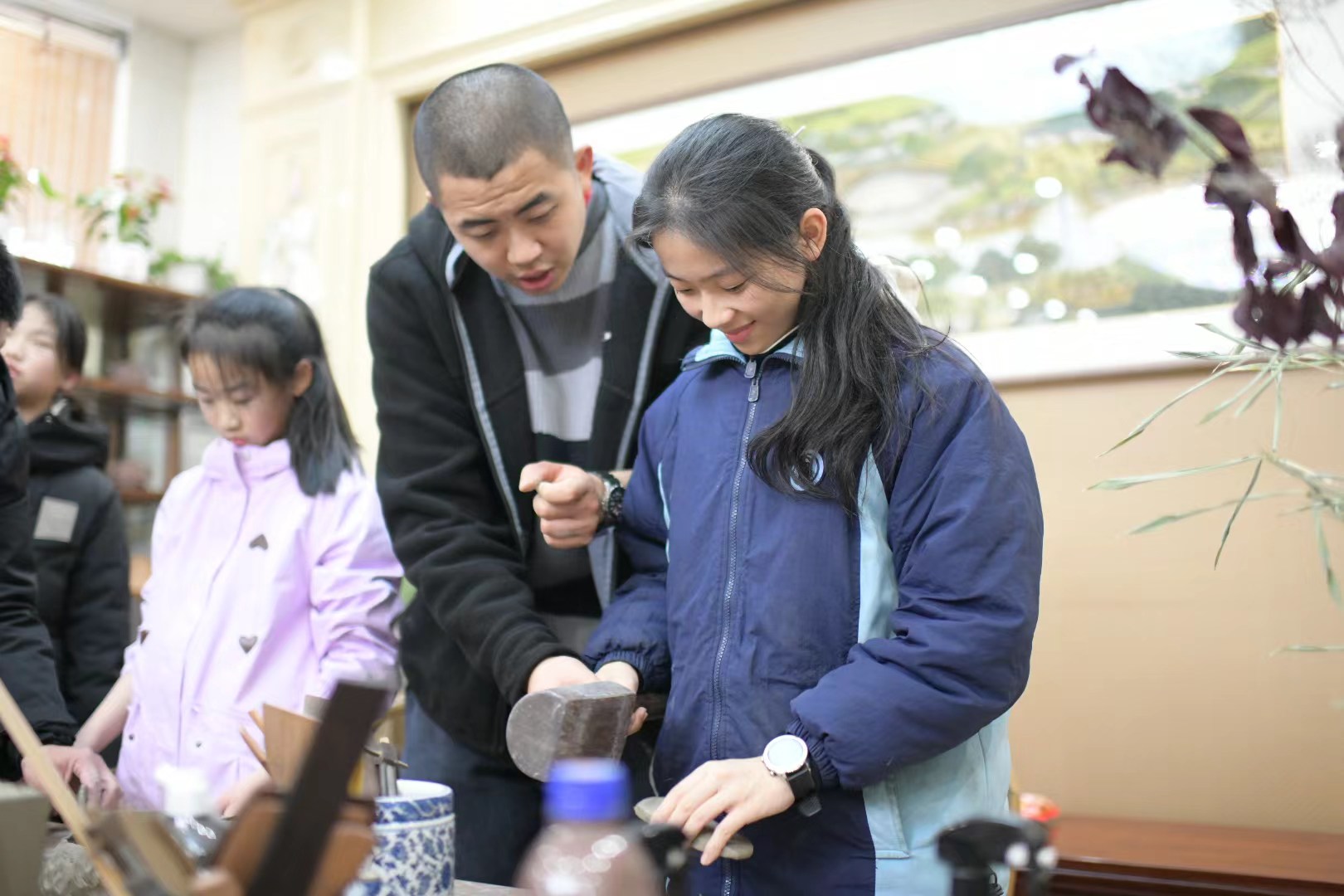
Pursuing teapot-making dream
On New Year’s Day, I went to Yixing, a city known for its clay teapots, to visit my mother’s friend’s family. Before the visit, I’ve heard my mom talking about her friend’s son, who is autistic, and a little part of how the family struggled for him and decided to let him study making teapots, which is a precious intangible cultural heritage in China. Since I just read a novel that has an autistic child as the main character, I was really interested in this group of people and wish to get more information about them. Therefore, I asked my mom if she could let me go with her, and she apparently agreed.
Before the visit, I did a lot of research and was really nervous. I was worried about whether the autistic boy would like to communicate with me since the internet says that the majority of the autistic do not like communicating nor socializing with other people. I was also anxious about some questions that I prepared: are those questions too offensive to ask? Would some of the questions bring back their bad memories and make them feel sad? If I really need some information, which method can I get it without making others have adverse feelings?
However, when I finally arrived, I found out that I worried too much. Not only the family members of the boy are really easy-going and enthusiastic, but the boy himself was extroverted and friendly as well. Though based on the research, I already know that some knowledge I had about autism before is purely stereotypical, I was still surprised at how he behaves. Before I stepped into the house, I wondered if I would see a taciturn boy sitting on the ground, focusing on his own stuff and paying no attention to the environment around him—at least a kind of introverted child like me, I thought. Nevertheless, the reality was completely opposite: there was a nearly two-meter-high adult standing in front of me, with a huge and amiable smile on his face, saying hello to me with a really large voice and waiting for me to introduce myself. And this is Tian, the son of my mother’s friend, a twenty-three-year-old autistic adult (which I thought to be an autistic child).
At the dinner table, Tian communicated with me actively, for example, asking me some basic questions such as how old am I and what I am studying, as well as asking me to teach him a little English. The interesting thing is, before we met, I was even considering how to make him be willing to chat with me, but it actually seems that I am the one who needs to be taught how to communicate since I am introverted and show a bit anxiety when talking to someone that I am not familiar with.
During the conversation with Tian, I found out some characteristics he has while speaking: First of all, there is hardly any difference in tone or volume when he expresses himself, making it difficult to know the exact feeling he has when making the speech. Second, his speech is relatively formal and written, without any idiom or rhetorical device. According to the information I got from his parents, I believe that this is associated with the primary way he studied language, which is reading books. Because of the habit of reading books and watching movies, he also adds a lot of famous sayings when speaking nearly unconsciously. Moreover, he always stares at the person who is talking to him, showing great respect and sincerity. Last but not least, it seems that he is more used to organizing a complete sentence in his brain before saying it out, leading to some noticeable pauses and relatively more fluent and rapid speaking. Although there are indeed some distinctive traits, Tian absolutely can communicate with others perfectly, much better than I thought. And the process of contacting him is quite interesting, and I truly enjoy the process.
When Tian went playing basketball with his friends, I got the opportunity to talk with his mother and listen to some stories about Tian and his family.
“When Tian was three years old, he was diagnosed with severe intellectual disability and infantile autism. However, I firmly believe that he does not have any intellectual problems—he merely has language disorders. And it turns out that I was right. At that time, I could feel that he had his own world, because he even created his own language. He makes odd sounds, which represent different objects or meanings to him. I can understand after hearing those sounds and seeing his actions for hundreds of times, but I knew that I must pretend that I could not understand, or he could never learn how to talk.
“At first, I didn’t want to admit that he was so special—because I couldn’t accept it at that time. Therefore, I sent him to a regular school at first, comforting myself that he was just like all the other normal children. However, his life in the regular school wasn’t that good. His classmates laughed at him, isolated him, and said a lot of bad words… And finally, I realized that I had to make some changes.
“I talked with my friend, and she told me that I must try to accept him, completely. She told me that if I continued hiding him, trying not to let anybody know that he is special, he would definitely experience a hard time in regular schools, and what’s more, he couldn’t even have the chance to enjoy the resources and service that are specially prepared for the minority—and these are what he should have enjoyed, undoubtedly. At the same time, with the doctor’s advice, I decided to send him to the special school for the mentally retarded.
“Between his three and eleven, we broke the bank to buy many different medicines and assorted therapies. It made us so stressed that our family relationship was poor for a period of time. But his father and I were both calm and rational. One day we just sat down and discussed— our son’s future, how can we help him, and whether we are going to get another child. The conversation lasted long, allowing both of us to be clearer about some questions: We are not going to get another child, because it will be unfair for both of our children—the second child will suffer from excessive stress since it seems that all of our hopes are on him, and the first child cannot get much care and love than before as well. After analyzing and thinking over some questions, our family relationship was harmonious again, and we decided to bring him to Yixing for better development. Family relationships are just so essential. A lot of parents with an autistic child finally break up, because they are always blaming each other, and then they get a divorce, then most of them will choose to let the child’s grandparents look after the child for them. Therefore, the child will lack love and companionship, which definitely hurts the mental health of the child.
“When Tian was almost twelve, in 2011, we changed our course and came to Yixing. Tian feels pretty good in his new school there. He made great progress in language skills, from ten percent to about eighty percent, meaning that he hardly has any problem communicating with others. Because he is outgoing and would like to take part in a lot of activities, his teachers all like him very much. His favorite is Music and English. He already got the guitar level ten certificate, and he can play the clarinet as well. For the autistic, it may be harder for them to start and to learn something, but they can gain great progress much more quickly than normal children. He is really patient when studying and always shows great passion. He likes learning English, so he watches a lot of English videos and movies. He even listens to English when taking a shower. In his spare time, he plays basketball with his father and friends, practices calligraphy, and watches movies. We are very satisfied with his lifestyle now, and he also enjoys it.

“I know that he has always been perfect. He is actually highly intelligent, he has super good memory: he can clearly memorize all the people he has met, the exact time they met, their names, what they were wearing, where each of them was sitting at the dinner table—even after many years. He can also memorize all the stations on all the lines, hundreds of stations in the correct order, even if he has only gone through the line for one time. He can also memorize all the roads, so I am never worried about getting lost when going out with him. He has great observational ability as well. He is good at observing others’ facial expressions and analyzing their feelings. I cannot hide anything from him, he knows everything, what I’m truly thinking about, and when I’m lying. He always manages himself well. He remembers where all the objects are placed, and can recognize when something is lost the first. For example, he would shout out loud “Where are the scissors? It should be placed right here, but it’s gone!” At first, I was used to putting things casually, but because of him, I developed the habit of putting things back to the place they used to be.
“His father and I like reading books, and we created a great environment for him. When he sees that we are both studying, he will try to read some books and practice language as well. We also love teapots very much—which is one of the reasons why we decided to come to Yixing. His father has a large collection of teapots, making Tian becoming interested in teapots as well. One day, Tian asked me “Mom, do you know what I really want to do?”, and he said, “Teapots! Making teapots! That’s what I really want!” We always support him in doing all the things he wants to do, so we began to help him find a teacher. It was really hard at first since hardly anyone would like to have an autistic child as a student and to teach him such a difficult skill. Then we struggled for a long time and finally succeeded—we found a great teacher for him. Now Tian can make various kinds of beautiful teapots, and we are all very proud of him.
I was really surprised when I heard this because, before the conversation, I had always believed that making teapots was something Tian’s parents arranged for him to do. Nonetheless, it is actually something that Tian himself offered to do. I felt fortunate for him to have such supportive parents who struggled for years to help him pursue his dream and to get better development. Tian’s mother showed me the first teapot he made. There are a few dots on the teapot, in a strange arrangement. “Tian told me that those are stars,” his mother said, “because people said that autistic children are the children from the stars, he likes to put stars in many of his works.” According to his mother, Tian’s brain is “closed”, leading to his high intelligence and fantastic memory, but also resulting in his lack of imagination and creativity. “At least it shows that he has his own thoughts, and he is courageous enough to create, as well as showing his inside by works.”

I spent one day and a half with Tian, and I deeply felt the importance of family education and family environment in the process. Tian and his father are typical “j” people in my eye (“j” stands for “judgment” in the MBTI 16 personalities test). Tian’s father showed me his thick notebook which records his daily. For every day, there is a detailed list of all the things that he is going to do and the corresponding time of all the things. There are also book notes, habitat clocking, and so on. Clearly, he had guided Tian to develop great habits as well, such as jogging in the morning, reading books, practicing calligraphy and meditating.
Besides, Tian is also a warm-hearted, courteous and cultivated person. He always picks up the leftovers after we finish dinner, and said that the stray dogs in the community always bark happily when they see those chicken; When playing the guitar at night, he always smiles at the camera when noticing others taking photos, being confident and modest at the same time. He got hurt when making teapots, and when playing the guitar, he had to change several band-aids since his fingers got sweaty. Facing others’ concerns, he merely shook his head and said: “It’s not that serious. I never find excuses for myself. Getting hurt is something inevitable, and we must sacrifice something to gain progress.
Late at night, I was busy with some psychology quizzes, and Tian was curious about what I was doing. After explaining, he told me excitedly that he also set questions for himself when studying Mathematics, and he really found it effective. Moreover, he asked me if I would like to help him with his undergraduate English test. I was so moved that I still cannot forget the earnestness in his eyes—it seems that he always got motivation and enthusiasm when studying things that he truly likes, and he is really living the life he aspired to and realizing the special value of his own life.
Even though it has already been two months, I still seldom recall some pictures: Tian and his father playing basketball together, each with a big smile on their face; Tian performing a new music with his injured but flexible fingers; Tian’s mother telling stories with a gentle voice, and showing all of us the teapots made by her son and husband with proud and happiness in her expression of eyes. Their love and care are expressed by the vivid stories of the past, by their eyes, by their actions, and by every single smile and speech.
This experience also reminds me of a saying by an autistic woman: “We need all hands on deck to write the ship of humanity. As we sail into an uncertain future, we need every form of human intelligence on the planet working together to tackle the challenges that we face as a society. We can’t afford to waste a brain.” A lot of us assume too many limitations and rules for the minority that we almost neglect that they can actually do a lot of things, and they can even do some specific things much better than “normal” people. The point is that whether you are patient enough to observe them and help them to realize and discover themselves, to put more attention on their talents and potentials instead of their flaws or “abnormality”. There are so many possibilities that should have been seen, but there are so many potentials and talents that have been wasted because of the ignorance of the family. For me, the biggest reward of this visit is that I had the opportunity to intuitively feel how a family can influence a child, can change one’s future or even one’s whole life. And I finally found the reason why I am writing this article as well: I want to help more perplexed parents who cannot see the future of their children’s lives, and tell them to be patient, see potential, and finally let their children show their power. “Abnormality” should not lead to abandonment, and there are thousands kind of possibilities in an instant.